
How Warm Can an Outdoor Ice Rink Be? Why Real Ice Works at 75°F
Can outdoor ice rinks operate at 75°F? Learn how chillers keep real ice frozen, why cooler nights help, and how sunshine, wind and tents affect ice.
Contents
- Introduction
- How warm can it be outside for a real ice rink?
- The practical guideline: 70s during the day and 60s at night
- Why direct sunlight can be a bigger challenge than warm air
- Why wind is another enemy of outdoor ice
- How thoughtful rink design can extend the temperature range
- Can a structural tent help an outdoor ice rink operate in warmer weather?
- How can outdoor real ice stay frozen when the air is above 32°F?
- What is an ice rink chiller, and how does it work?
- Why building new ice is different from maintaining existing ice
- What happens when it rains on an outdoor ice rink?
- Can outdoor real-ice skating work in Florida, Texas, Georgia, or California?
- What should buyers ask before renting or purchasing an outdoor ice rink?
- Frequently asked questions about outdoor ice rink temperatures
- The bottom line: real ice doesn't require freezing weather
Imagine walking through a downtown plaza on a December afternoon. It's 75°F, the sun is shining, and spectators around an outdoor ice skating rink are wearing T-shirts.
Yet families are skating on genuine frozen ice.
It seems almost impossible. After all, water freezes at 32°F. How can an outdoor skating rink stay frozen when the surrounding air is more than 40 degrees warmer?
The answer surprises many people.
A properly designed refrigerated outdoor ice rink can operate with daytime temperatures in the 70s°F, particularly when nighttime temperatures fall into the 60s°F or cooler.
With additional attention to rink positioning, shade, wind protection, and refrigeration capacity, even warmer operating conditions may be achievable.
And here's something many people don't realize: direct sunshine and wind can sometimes create more difficult ice conditions than the air temperature itself.
Understanding why reveals how outdoor holiday ice skating works in places that rarely experience freezing weather.
How warm can it be outside for a real ice rink?
There is no single maximum outdoor temperature that applies to every refrigerated skating rink.
For general planning purposes, a useful guideline is daytime temperatures in the 70s°F, with nighttime temperatures dropping into the 60s°F or cooler.
That weather pattern can provide workable conditions for a professionally designed portable real-ice rink.
It doesn't mean the ice automatically starts melting when the thermometer reaches 80°F. Nor does it mean that every rink will perform successfully at 75°F.
The answer depends on the entire installation.
A shaded rink protected from warm winds may perform better at a higher air temperature than a completely exposed rink on a cooler day.
Some systems may be capable of operating in conditions beyond the general temperature range, particularly when the location and refrigeration equipment have been designed with warmer weather in mind.
For prospective rink buyers, the distinction is important.
The question isn't simply, "How hot can it get outside?"
The better question is, "How much heat will reach the ice, and can the refrigeration system remove that heat quickly enough to maintain good skating conditions?"
The practical guideline: 70s during the day and 60s at night
For many outdoor holiday rink projects, daytime temperatures in the 70s with nighttime temperatures falling into the 60s or lower offer a reasonable starting point.
That surprises event organizers who assume an outdoor rink needs freezing weather to function.
Consider a location where the temperature reaches 75°F in the afternoon but drops to 63°F overnight.
The refrigeration equipment operates throughout the daily cycle, but the environmental conditions change considerably.
During the day, the ice receives heat from warm air and, potentially, direct sunlight.
As the sun sets and the air cools, some of those heat loads decrease.
The result can be more favorable conditions for maintaining the ice and completing ice-building or maintenance work.
Why cooler nighttime temperatures make a difference
An outdoor ice rink doesn't experience the same refrigeration demand around the clock.
Here's an illustrative warm-weather day:
| Time of day | Air temperature | Conditions affecting the ice |
|---|---|---|
| Early morning | 64°F | Cooler air before peak daytime heating |
| Afternoon | 75°F | Warmer air and potentially strong direct sunshine |
| Evening | 69°F | Direct solar heating disappears |
| Overnight | 63°F | Cooler conditions can reduce refrigeration demand |
These temperatures are an example to explain the principle, not measurements from an operating rink.
Notice that the temperature never approaches 32°F.
Yet a properly designed mechanical refrigeration system may still maintain frozen ice in conditions like these.
This is one of the key differences between a refrigerated skating rink and a naturally frozen pond.
Why nighttime conditions are particularly useful when building ice
Creating a brand-new skating surface is different from maintaining one that is already frozen.
During installation, crews usually apply water in successive layers over the refrigerated floor.
The refrigeration system must remove heat from the water until it freezes, then continue cooling as the ice sheet develops.
That initial process requires substantial heat removal.
At night, the absence of direct sunshine and cooler air temperatures can reduce the environmental heat entering the surface.
This can create more favorable conditions for building ice, provided the refrigeration equipment has adequate capacity.
The nighttime temperature does not need to fall below freezing.
An outdoor air temperature of 63°F can be compatible with real-ice construction when mechanical refrigeration is doing the freezing.
For event organizers, the lesson is straightforward: consider the entire daily temperature cycle when planning installation and operating schedules, not just the afternoon high.
Why direct sunlight can be a bigger challenge than warm air
Imagine two identical outdoor ice rinks.
One is located in a shaded courtyard where the temperature is 75°F.
The other is in an open parking lot where the air is only 65°F, but bright sunshine falls directly onto the ice.
Which rink has the more difficult job keeping its surface frozen?
The answer may surprise you.
The warmer, shaded rink could experience less heat entering its ice than the cooler rink exposed to direct sunlight.
That's because sunlight delivers radiant energy directly to the skating surface.
This additional heat must be removed by the refrigeration equipment.
The air temperature shown on a weather app doesn't tell you how much solar energy is striking the ice.
This is why a sunny winter afternoon can be demanding even if the surrounding air feels relatively comfortable.
Why shade is so valuable
Shade limits direct solar heating of the skating surface.
Nearby buildings, the orientation of the rink, and appropriately designed overhead structures can all influence how much sunshine reaches the ice.
A rink that receives afternoon shade may be easier to maintain than one exposed to the sun throughout the day.
The position of the sun also changes with the season and time of day.
A location shaded in the morning might receive intense afternoon sunshine.
When selecting a site, event organizers should consider where shadows fall during the hours the rink will be operating.
A beautiful open plaza may seem ideal for holiday skating, but a nearby protected location might provide a better environment for the refrigeration system.
This doesn't mean every exposed site is unsuitable.
It means the exposure needs to be included in the rink's design and equipment selection.
Why wind is another enemy of outdoor ice
Wind is one of the most commonly overlooked challenges of outdoor ice skating.
When air is warmer than the skating surface, moving air can transfer heat to the ice.
Stronger air movement can increase that transfer and add to the refrigeration load.
Wind also influences moisture exchange at the surface, although its precise effect depends on temperature and humidity.
This creates a surprising possibility.
A calm, shaded day in the 70s can sometimes be more favorable than a cooler day with strong warm winds and direct sunshine.
Can a rink be protected from wind?
Yes.
Nearby buildings, appropriate barriers, and thoughtful site positioning can reduce exposure to prevailing winds.
But these protections must be designed with public safety, emergency access, and structural requirements in mind.
There is another important consideration.
Air-cooled chillers need adequate ventilation to reject the heat collected from the rink.
Protecting the skating surface from wind should not mean restricting airflow around the refrigeration equipment.
The ice and the chiller have different environmental needs.
A well-designed installation considers both.
How thoughtful rink design can extend the temperature range
The 70s-by-day and 60s-by-night guideline is a useful starting point, but it isn't necessarily the warmest condition in which real ice can operate.
With additional thought given to the design and positioning of the rink, warmer conditions may be achievable.
Several decisions can make a meaningful difference.
Position the rink to benefit from natural shade
Surrounding buildings and the orientation of the rink may help reduce direct sunshine, particularly during the warmest afternoon hours.
Reduce exposure to prevailing warm winds
Appropriate wind barriers and site positioning can help limit heat transfer across the ice.
The design must preserve safe access and adequate ventilation around refrigeration equipment.
Choose suitable insulation and floor construction
Appropriate insulation can reduce unwanted heat entering the ice from the ground or underlying surface.
The specific floor assembly depends on the refrigeration system and installation requirements.
Select refrigeration equipment for the actual conditions
A rink designed for warmer weather may need greater available cooling capacity than an otherwise similar rink operating in a cooler climate.
Refrigeration equipment should be evaluated for the actual operating conditions, including its performance at the required fluid temperatures.
Take advantage of cooler installation and maintenance periods
Building ice overnight and completing suitable maintenance activities during cooler hours can help reduce the environmental heat the refrigeration equipment must overcome.
Plan around the intended operating schedule
An evening-focused skating attraction may face different refrigeration demands from a rink operating continuously through sunny afternoons.
The schedule should be considered before finalizing the equipment and site layout.
A properly positioned and engineered rink may be capable of operating in temperatures higher than the general 70s°F recommendation.
That doesn't guarantee unlimited temperature tolerance. It means the complete design matters more than a single number on the thermometer.
Can a structural tent help an outdoor ice rink operate in warmer weather?
Yes. When an event organizer has concerns about direct sunlight, rain, or excessive wind, a properly engineered structural tent can be an effective option.
In consultation and agreement with the rink supplier, a large temporary tent or covered structure can be considered for the skating surface.
The most important refrigeration advantage is protection from direct solar radiation.
By keeping sunlight off the ice, the structure reduces an important source of unwanted heat.
Depending on its design, the covering may also provide protection from rainfall and help limit wind exposure.
That can make the refrigeration system's job more manageable and may improve the consistency of the skating surface.
However, covering a rink doesn't eliminate the need for properly sized refrigeration equipment.
A structural tent must also account for wind and other structural loads, ventilation, humidity, drainage, permitting, fire safety, and public access.
The structure should be evaluated together with the rink supplier and qualified structural professionals.
Evans on Ice: when the tent becomes part of the holiday attraction
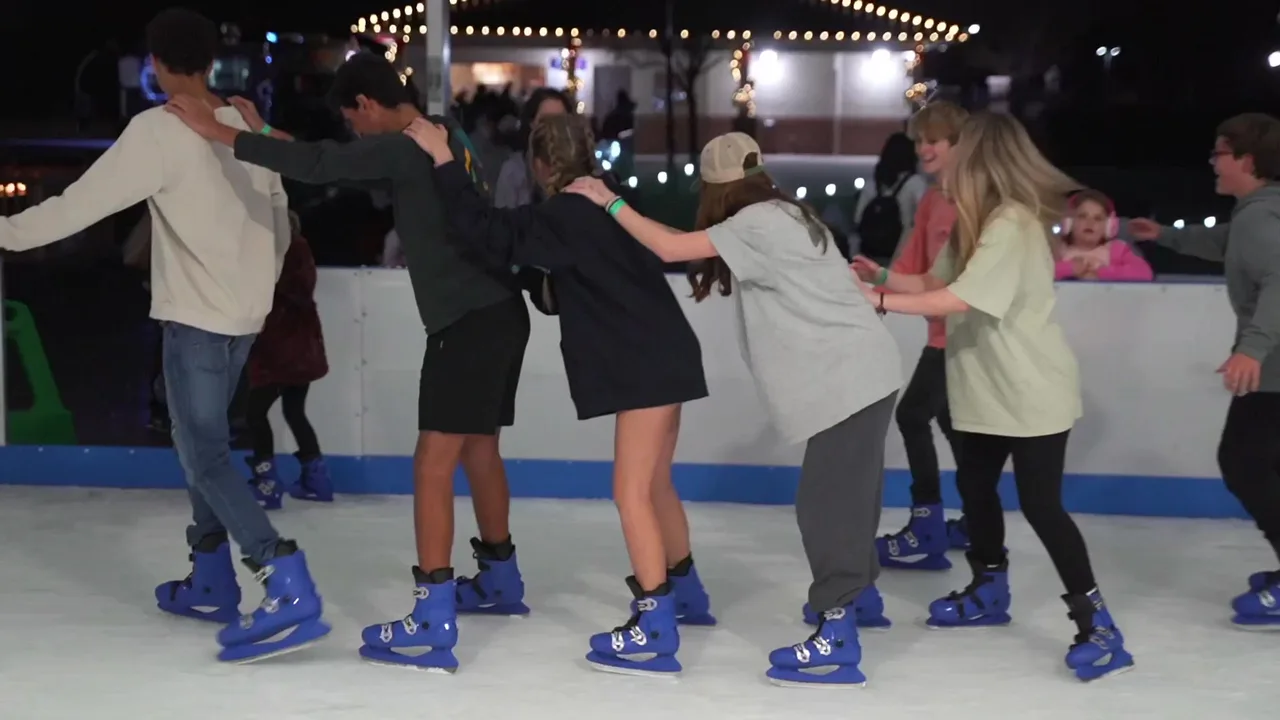
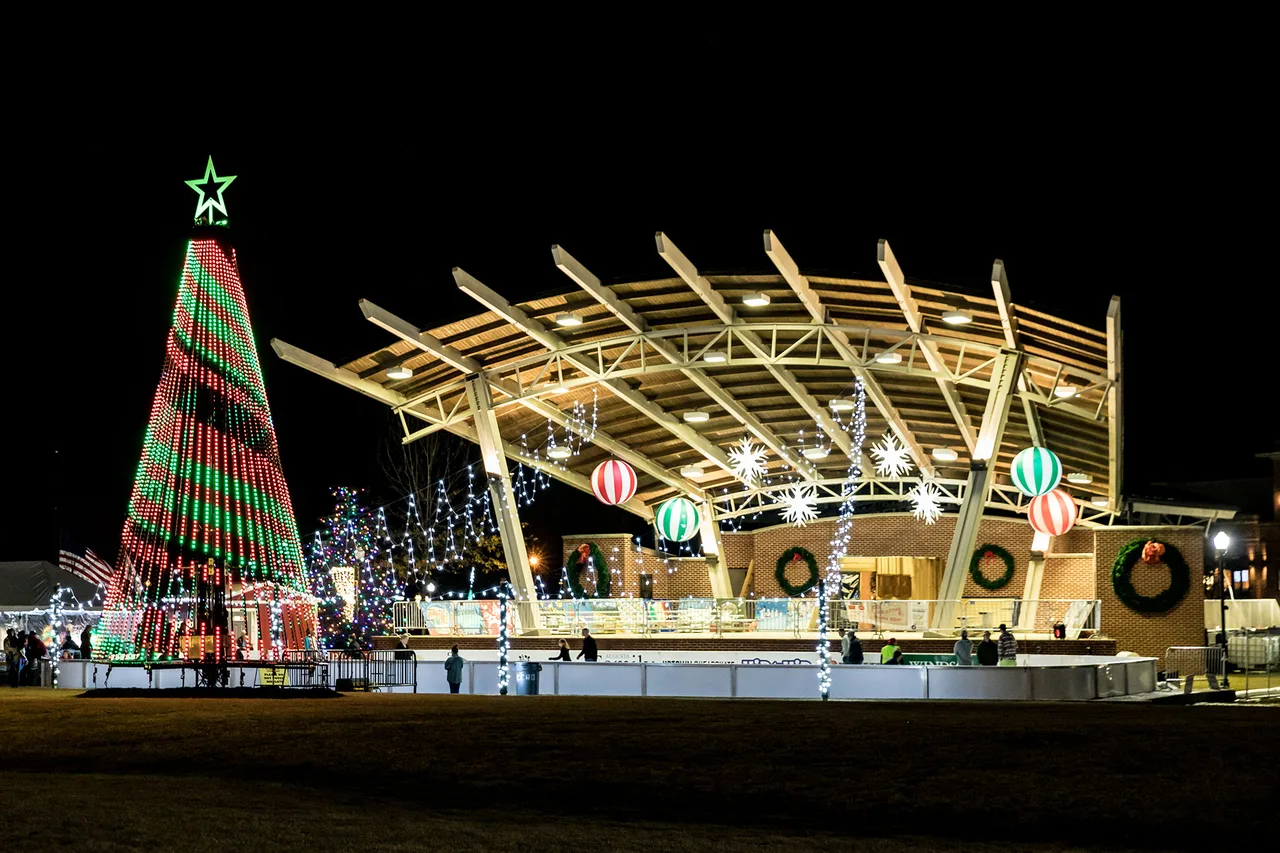
An excellent example is Evans on Ice at Evans Towne Center Park in Evans, Georgia.
Evans on Ice features a fully covered outdoor real-ice rink with mechanical refrigeration.
The covered skating area helps shield the ice from direct sunshine and provides weather protection.
But the structure does something else that's equally interesting for holiday-event planners.
It becomes part of the attraction.
Inside the covered rink, large suspended holiday ornaments, illuminated snowflakes, and festive decorations create an inviting seasonal atmosphere.
Rather than looking like a purely functional enclosure, the structure helps transform the rink into a holiday destination.
For cities, shopping centers, resorts, and event organizers, this example demonstrates how a covering can potentially deliver two benefits at once.
It can help protect the ice from challenging weather while creating a memorable, decorated setting for visitors.
The roof provides space for coordinated lighting and suspended decorations, while the skating activity becomes the centerpiece of the holiday experience.
The covering is no longer just protective equipment. It becomes part of the event's visual identity.
Is a covered rink always the best choice?
Not necessarily.
A naturally shaded and sheltered location may perform well without a tent.
Some organizers may prefer the completely open-air experience of skating beneath the sky.
A structural covering also adds cost, installation requirements, and engineering considerations.
Depending on its design, it may affect humidity, airflow, and the environment around the skating surface.
For these reasons, a tent should be considered in agreement with the rink supplier, rather than added as an afterthought.
But if direct sunshine, warm weather, or rain presents a concern, a properly engineered covering is an option worth evaluating before deciding that a proposed outdoor rink location is unsuitable.
And when decorated thoughtfully, it can enhance the holiday attraction rather than detract from it.
How can outdoor real ice stay frozen when the air is above 32°F?
The explanation comes down to mechanical refrigeration.
A naturally frozen pond depends on sufficiently cold weather.
A refrigerated ice rink uses equipment to remove heat from beneath the skating surface.
Under the ice is a network of cooling tubes or portable refrigeration mats.
These circulate a chilled liquid that absorbs heat from the surface above.
The liquid travels back to a refrigeration machine, where the heat is removed.
It then returns to the rink and repeats the process.
As long as the system can remove sufficient heat to meet the conditions, the skating surface can remain frozen even when the surrounding air is warmer than 32°F.
The equipment isn't trying to freeze the entire outdoor environment.
It's removing heat from the skating surface.
That's why spectators can stand beside an outdoor rink wearing short sleeves while skaters glide across real frozen water.
What is an ice rink chiller, and how does it work?
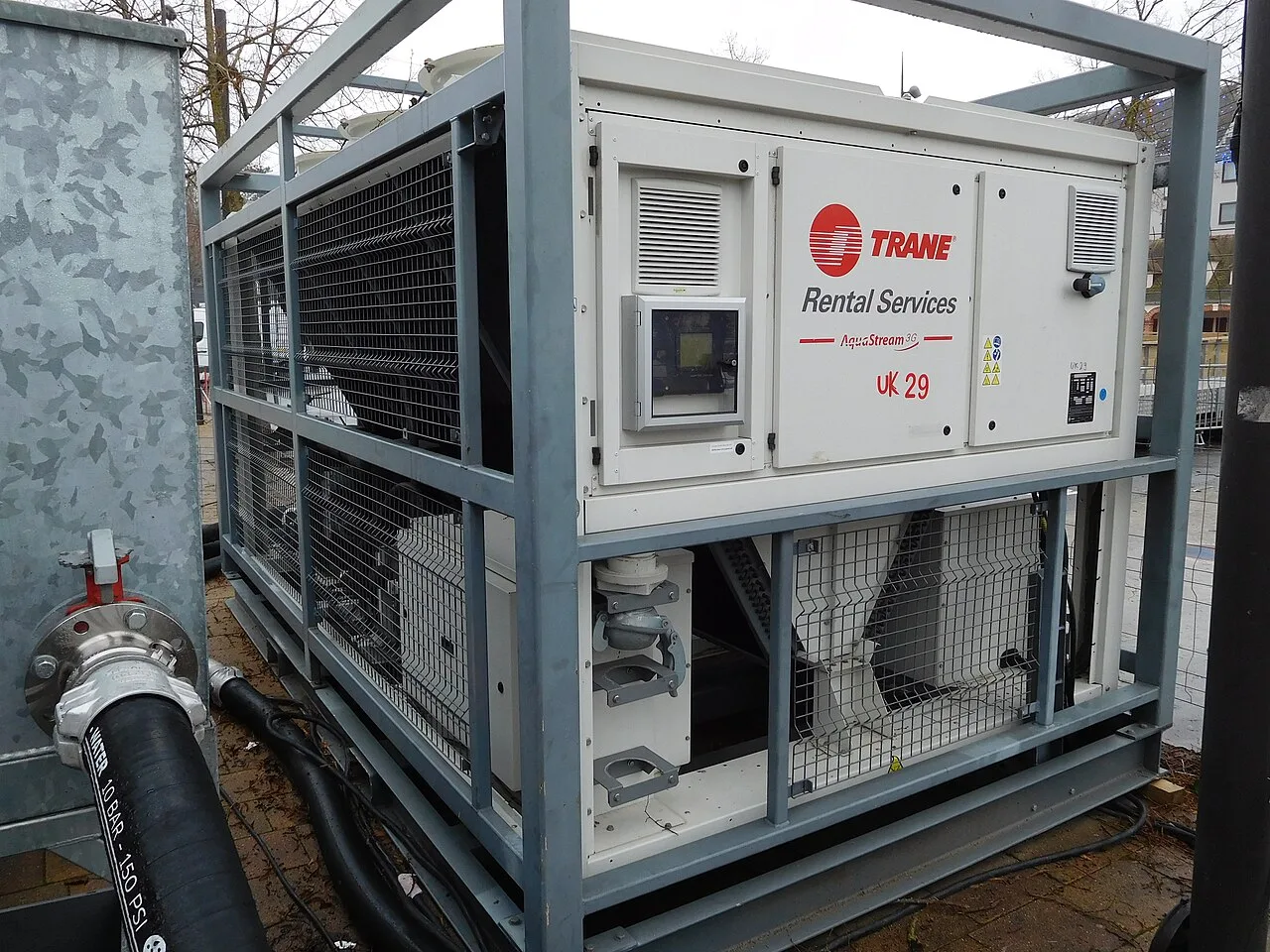
A chiller is the refrigeration machine that removes heat from the liquid circulating beneath a refrigerated ice rink.
Think of it as a large commercial refrigeration unit connected to a specially designed cooling floor.
A household refrigerator removes heat from inside its cabinet and releases that heat into the surrounding room.
An ice rink chiller performs the same basic function on a much larger scale.
Instead of cooling food, it cools the liquid circulating through the rink floor.
Step 1: The chiller cools the circulating fluid
Many portable refrigerated rinks use a mixture of water and glycol.
The glycol helps prevent the liquid from freezing at the temperatures needed by the system.
The circulating fluid remains inside the cooling circuit. It isn't poured onto the ice.
Step 2: Pumps move the fluid beneath the skating surface
The cooled liquid travels through supply piping into a network of closely spaced cooling tubes or portable mats beneath the ice.
These distribute refrigeration across the rink.
Step 3: The fluid absorbs heat from the rink
Heat from the ice and its surroundings moves toward the colder cooling system beneath the skating surface.
As the liquid circulates through the tubing, it absorbs heat.
Step 4: The fluid returns to the chiller
By the time the liquid returns to the refrigeration equipment, it has absorbed heat and is somewhat warmer.
The chiller removes that heat using a separate refrigeration circuit.
The collected heat is ultimately released into the surrounding environment.
Step 5: The process repeats continuously
The cooled liquid travels beneath the ice again.
Pumps, refrigeration equipment, and controls work together to maintain suitable skating conditions as the weather changes.
On a sunny afternoon, the rink may require substantially more cooling than during a shaded, cooler night.
This continuous heat-removal process is what makes outdoor real-ice skating possible in warm climates.
What does a 100-ton ice rink chiller mean?
In refrigeration, a ton describes cooling capacity, not the physical weight of the machine.
One refrigeration ton equals 12,000 BTU of heat-removal capacity per hour.
A 100-ton chiller therefore has a nominal cooling rating of 1.2 million BTU per hour under specified conditions.
That doesn't mean every outdoor ice rink needs a 100-ton chiller.
The appropriate equipment depends on the rink's size, weather exposure, floor design, cooling-fluid temperatures, and operating requirements.
A machine's actual available capacity may also change depending on operating conditions.
Two identically sized outdoor rinks can require different refrigeration arrangements if one is shaded and the other receives direct sunshine throughout the afternoon.

Why building new ice is different from maintaining existing ice
Building an ice rink requires more than simply turning on the refrigeration equipment.
The floor must be cooled sufficiently, and water is normally added in successive layers.
The refrigeration system removes heat from each layer until it freezes.
As the ice sheet develops, additional layers are added until the appropriate thickness and surface conditions are achieved.
Once the rink is operating, the refrigeration equipment must continue removing heat introduced by the environment and skating activity.
These are related but different refrigeration tasks.
It may be possible to maintain an existing frozen surface through a warm afternoon while finding that same afternoon less favorable for building the initial ice sheet.
This is why cooler nighttime conditions are particularly valuable when planning installation schedules.
What happens when it rains on an outdoor ice rink?
Rain introduces water and heat onto the skating surface.
The refrigeration equipment must remove that additional heat.
Depending on the conditions, the ice may develop puddles, softer areas, or an uneven surface.
Even a powerful refrigeration system cannot guarantee suitable public-skating conditions throughout heavy rainfall or severe weather.
Operators may need to temporarily close the rink, remove excess water, perform maintenance, or wait for conditions to improve.
A structural covering can help reduce direct rainfall reaching the ice, but it does not eliminate every weather-related concern.
Humidity also matters.
Warm, humid air can introduce additional heat as moisture condenses or forms frost on a cold surface.
For this reason, warm-weather rink planning should consider humidity, rain, and local weather patterns alongside temperature.
Can outdoor real-ice skating work in Florida, Texas, Georgia, or California?
Yes.
Mechanical refrigeration allows real-ice skating attractions to operate in regions where natural ice would rarely form.
An event location experiencing daytime temperatures in the 70s with overnight lows in the 60s may be a realistic candidate for a properly designed outdoor rink.
But two locations in the same city can have very different requirements.
A shaded downtown courtyard may be easier to refrigerate than an exposed parking lot.
A rink sheltered by surrounding buildings may experience different wind loads from a waterfront installation.
A fully covered rink may receive considerably less direct solar heating than an uncovered surface.
And a rink operating mainly in the evening may encounter different conditions from one operating throughout the afternoon.
The actual site and refrigeration design are therefore central to determining feasibility.
The Evans on Ice example demonstrates how a covered real-ice attraction can function in a mild-weather region while also creating a festive holiday setting.
What should buyers ask before renting or purchasing an outdoor ice rink?
A city, shopping center, resort, or event organizer should look beyond a supplier's advertised maximum operating temperature.
Before committing to a location or equipment package, consider these questions:
What temperatures are expected during the day and overnight?
Evaluate the complete daily weather pattern rather than relying only on the average temperature or afternoon high.
How much direct sunshine will reach the skating surface?
Determine whether natural shade or an appropriately designed covering could reduce exposure.
How exposed is the rink to wind?
Consider prevailing winds and whether site positioning or suitable barriers could reduce the impact.
Would a structural tent improve the installation?
Discuss the option with the rink supplier, including weather protection, holiday decoration opportunities, structural requirements, and cost.
How is the refrigeration equipment sized?
Ask what assumptions were used regarding weather, sunlight, ice-floor design, and operating conditions.
What electrical service and equipment space are required?
Commercial refrigeration machines may require substantial electrical power, ventilation, and access.
How will the ice be built and maintained?
Understand the installation schedule, water supply, drainage, resurfacing equipment, and daily maintenance responsibilities.
What happens during unusually warm weather or rain?
Ask about operating limitations, potential interruptions, and the procedures used to restore ice quality.
A responsible supplier should consider the entire proposed installation rather than promise that every rink will perform identically in every climate.
Frequently asked questions about outdoor ice rink temperatures
Can an outdoor real-ice rink operate at 75°F?
Yes. A properly refrigerated outdoor rink can operate with daytime temperatures around 75°F under suitable conditions. Nighttime temperatures in the 60s or cooler, adequate refrigeration, shade, and manageable wind exposure can all contribute to successful operation.
What is the maximum outdoor temperature for an ice rink?
There is no universal maximum. For general planning, daytime temperatures in the 70s with nighttime temperatures in the 60s or cooler provide a useful reference. Some appropriately engineered installations may operate in warmer conditions.
Can you build ice when it's 70 degrees outside?
Yes. A properly designed refrigeration system can freeze water even when outdoor air is above 32°F. Cooler nighttime conditions and the absence of direct sunshine can make initial ice construction more favorable.
Does an outdoor ice rink need freezing temperatures at night?
No. Mechanically refrigerated rinks don't require outdoor temperatures to fall below freezing. Nighttime temperatures in the 60s can be compatible with ice building and maintenance when the cooling system has adequate capacity.
Can a portable ice rink operate at 80°F?
Some specially designed installations may be able to maintain real ice at 80°F or warmer. However, that should not be assumed for every portable rink. Feasibility depends on refrigeration capacity, sunshine, wind, humidity, and the complete site design.
Is sunlight worse than warm air for outdoor ice?
It can be. Direct sunlight adds radiant heat to the skating surface that isn't reflected in the air temperature alone. A shaded rink on a warmer day may sometimes be easier to maintain than a cooler rink exposed to bright sunshine.
Can a tent help keep an outdoor ice rink frozen?
Yes. A properly designed structural covering can block direct sunlight, reduce precipitation reaching the ice, and potentially limit wind exposure. It can also provide a framework for lighting and holiday decorations. The structure and refrigeration system should be planned together.
Does an outdoor ice rink chiller run overnight?
Refrigeration generally remains available outside public skating hours to maintain the surface. The equipment may cycle or adjust its operation according to the cooling demand. Cooler nights and the absence of direct sunshine may reduce the refrigeration load.
Is a portable refrigerated rink made with real ice?
Yes. A refrigerated real-ice rink uses actual frozen water. Cooling equipment removes heat through pipes or mats beneath the skating surface. Synthetic skating rinks use manufactured panels rather than frozen water.
The bottom line: real ice doesn't require freezing weather
Most people associate ice skating with temperatures below 32°F.
But a refrigerated outdoor rink doesn't depend on freezing outdoor air.
For general planning purposes, daytime temperatures in the 70s°F and nighttime temperatures falling into the 60s°F or cooler can provide workable conditions for appropriately designed portable real-ice rinks.
With more careful attention to site positioning, shade, wind protection, insulation, and refrigeration capacity, warmer conditions may also be achievable.
Where weather exposure presents a concern, an appropriately engineered structural tent can offer another solution. As Evans on Ice demonstrates, such a structure can also become part of an attractive holiday experience.
The real issue isn't simply how warm the weather gets.
It's how much heat enters the ice and whether the refrigeration system can remove enough of that heat to maintain suitable skating conditions.
That's how families can enjoy genuine outdoor ice skating on a sunny afternoon when the thermometer reads 75°F.
And it's why planning a successful warm-weather holiday rink begins with thoughtful design—not a requirement for freezing temperatures.
Related IceRinkGuide reading
- How Temporary Ice Skating Rinks Are Made
- Temporary Ice Rink Planning Guide
- Temporary Ice Rink in a Parking Lot
- Evans on Ice — Evans, Georgia
Technical reference
ASHRAE Refrigeration Handbook — Ice Rinks.
Use this as the independent technical foundation for general refrigeration principles, heat transfer, solar radiation, humidity, and air movement.
The practical operating-temperature guidance comes from owner-supplied ice-rink industry experience. Do not falsely attribute the exact 70s/60s recommendation or higher-temperature possibilities to ASHRAE.