
How to Plan a Temporary Ice Skating Rink for Your City or Holiday Event
An independent planning guide for municipalities, downtown organizations, shopping centers and event producers considering a seasonal real-ice skating rink.
A temporary ice skating rink can transform an ordinary town square, parking lot, shopping-center courtyard or event space into a winter attraction.
The idea sounds straightforward: install a rink, freeze the water, rent out skates and welcome visitors.
In practice, a successful holiday rink requires considerably more preparation.
Someone must coordinate the site, refrigeration, electricity, installation, ice maintenance, staffing, visitor amenities, insurance and eventual removal.
A city or event organizer does not necessarily need to own an indoor arena or employ an ice-making department to explore the idea.
But before requesting proposals, organizers should understand the different components of a seasonal rink project and determine what responsibilities they are prepared to handle.
This guide explains how temporary real-ice rinks work, what to consider when selecting a location, how rental and purchase arrangements differ, and how to organize a realistic planning process.
What is a temporary ice skating rink?
A temporary ice skating rink is an ice surface installed for a limited period and removed when the event or season ends.
Unlike a permanent indoor arena, it may be constructed over an existing paved plaza, parking lot, park area or specially prepared platform.
For most commercial holiday attractions, the rink uses a mechanical refrigeration system to maintain real ice.
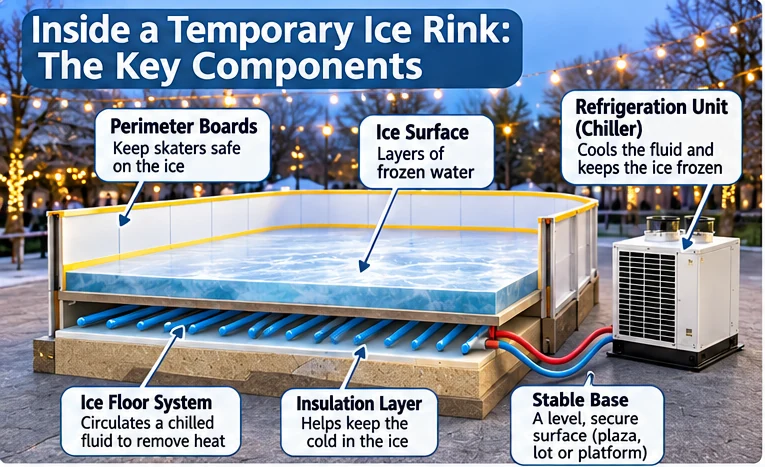
Underneath the skating surface, a network of cooling pipes or portable mats circulates chilled liquid. Refrigeration equipment removes heat from the liquid, allowing water above the cooling system to freeze.
This is the standard approach described in the ASHRAE Refrigeration Handbook's chapter on ice rinks, which explains that an ice sheet is usually frozen by circulating a heat-transfer fluid through a network of pipes or tubes located below the surface of the ice.
Once the rink opens, that equipment continues removing heat introduced by air, sunlight, precipitation and skating activity.
This is why many refrigerated outdoor rinks can operate even when the air temperature rises above 32°F.
However, the system must be designed for the specific location and anticipated weather.
Not every temporary rink uses the same construction method. Some systems use different flooring assemblies, cooling layouts or refrigeration configurations.
For a closer look at the equipment, read How Temporary Ice Rinks Are Made.
1. Decide what you want the rink to accomplish
Before contacting contractors or preparing a budget, define the project's purpose.
A community skating rink might provide affordable recreation for residents.
A downtown business association may want to attract visitors during the holiday shopping season.
A shopping center may use skating as an additional reason for families to visit the property.
Common objectives include:
- Supporting an existing Christmas market or winter festival.
- Increasing activity in a downtown district.
- Creating an annual community tradition.
- Offering recreational activities for families.
- Hosting school groups and private events.
- Building sponsorship partnerships.
- Encouraging visitors to explore neighboring businesses.
The project's purpose influences its size, location, admission pricing, operating schedule and financial model.
A community recreation project may prioritize accessibility and affordable admission.
A commercial event may emphasize ticket revenue, private bookings and extended operating hours.
Neither approach is automatically preferable.
What matters is deciding how the project's success will be measured before making major financial commitments.
2. Choose the right location
Temporary rinks can be installed in many settings, but not every open space is suitable.
If a parking lot is the leading candidate, see our guide to putting a temporary ice rink in a parking lot, which covers space, slope, power, water, drainage and permitting for paved sites.
A successful location requires more room than the skating surface alone.
The surrounding area must accommodate arrivals, skate rentals, changing areas, queues, equipment, supervision and pedestrian circulation.
A preliminary site review should consider several factors.
Ground conditions: Is the existing surface reasonably level, stable and suitable for the intended installation? Will a temporary platform be required?
Electricity: Is sufficient electrical service available near the site? Will temporary distribution or power generation be necessary?
Water: Is there a reliable supply for initial ice-making and daily maintenance?
Drainage: Where will rainwater, resurfacing water and melted ice go?
Equipment placement: Is there an appropriate location for refrigeration equipment, considering ventilation, noise, access and public separation?
Delivery access: Can freight vehicles and installation crews reach the location safely?
Public circulation: Is there sufficient room for guests, wheelchair access, emergency services and staff?
Surroundings: How might sunlight, shade, trees, buildings, traffic and neighboring businesses affect operations?
A parking lot may initially appear ideal because it offers open space and vehicle access.
But a significant slope, insufficient electricity or drainage problems may change the project's feasibility and budget.
For a city-owned site, it is useful to involve public works, parks and recreation, facilities management and the relevant utility providers early.
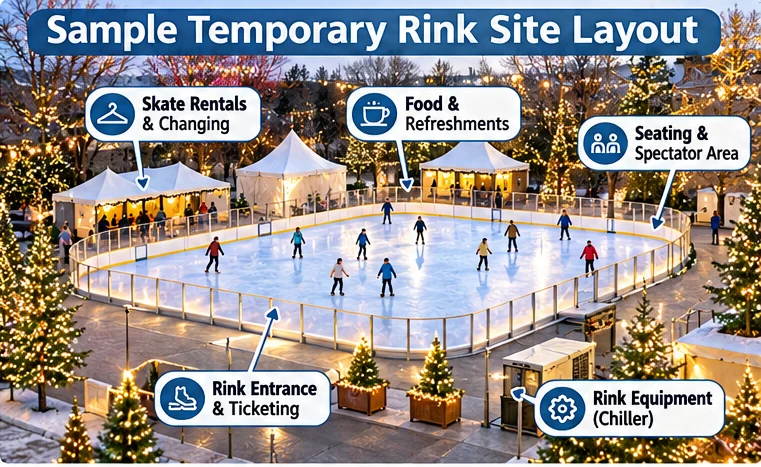
The accompanying illustration is a conceptual arrangement rather than a required equipment layout. Actual sites must be designed individually.
3. Decide how large the rink should be
There is no universal ideal size for a temporary holiday ice rink.
The appropriate footprint depends on available space, anticipated demand, skating activities and the overall budget.
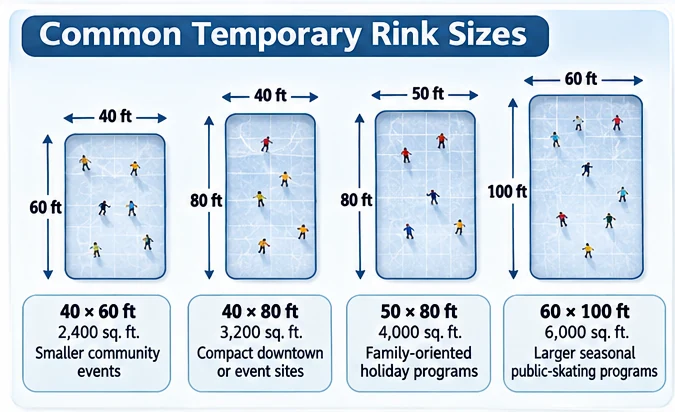
The following dimensions are illustrative planning examples.
| Example rink size | Ice surface area | Possible application |
|---|---|---|
| 40 × 60 feet | 2,400 sq. ft. | Small community event |
| 40 × 80 feet | 3,200 sq. ft. | Compact downtown attraction |
| 50 × 80 feet | 4,000 sq. ft. | Family-focused holiday program |
| 60 × 100 feet | 6,000 sq. ft. | Larger seasonal skating event |
| 60 × 120 feet | 7,200 sq. ft. | Higher-throughput public skating program |
These categories are examples, not standards or guarantees.
A larger rink may support more skating activity, but it typically requires more floor equipment, cooling capacity, water, site area and installation work.
The usable skating surface is also not the same as the total space required for the event.
Visitor amenities, refrigeration equipment, access routes and emergency circulation need additional room.
Safe occupancy should never be estimated from a generic square-footage formula without accounting for the design, activities, supervision and applicable safety requirements.
A smaller, well-managed rink may deliver a better community experience than an oversized project that stretches the budget and operating resources.
4. Understand the equipment that makes real ice possible
A refrigerated temporary ice rink generally relies on several connected systems.
Portable ice floor: Cooling mats, pipes or modular sections positioned below the skating surface.
Refrigeration equipment: A chiller or other refrigeration plant that removes heat from the circulating fluid.
Pumps and distribution connections: Components that circulate the chilled liquid between the refrigeration equipment and the rink floor.
Floor protection and insulation: Site-dependent layers that may help control heat transfer, protect existing surfaces or manage moisture.
Perimeter boards: Barriers defining the skating surface and providing appropriate points of entry and exit.
Ice-making and maintenance equipment: Tools and machines for constructing, maintaining and resurfacing the ice.
Visitor equipment: Rental skates, skate racks, benches, changing spaces and optional beginner skating aids.
The equipment package is only one part of the overall attraction.
Electrical distribution, site preparation, operating personnel, ticketing systems, maintenance labor and insurance may be separate responsibilities.
This distinction is especially important when comparing proposals that appear to offer similar rink sizes but include different services.
5. Can a temporary ice rink work in a warm climate?
Yes.
Refrigerated real-ice rinks can operate in climates where outdoor temperatures frequently exceed freezing.
This is why seasonal real-ice attractions can be found in California, Florida, Georgia, Texas and other relatively warm regions.
Rather than depending entirely on naturally freezing weather, the refrigeration system actively removes heat from the ice.
However, warmer air, direct sunlight, humidity, wind and rain all affect the conditions the system must handle.
A rink designed for a shaded northern plaza may require a different engineering approach from one installed on an exposed southern parking lot.
Reliable planning should consider:
- Local weather patterns.
- Expected opening and closing dates.
- Daytime and nighttime temperatures.
- Sun exposure and shade.
- Humidity.
- Rainfall and drainage.
- Site elevation and surrounding structures.
- Operating hours and expected skating activity.
Indoor temporary rinks introduce different considerations, including humidity, ventilation, condensation and protection of surrounding building areas.
The question isn't simply whether real ice can be created in a particular city.
It is whether the proposed installation can maintain a suitable skating surface under the actual operating conditions.
6. Allow sufficient time for installation and ice-making
A temporary rink cannot always be delivered, assembled and opened immediately.
A project generally moves through several stages:
- Site preparation.
- Delivery and unloading.
- Floor and perimeter installation.
- Utility and refrigeration connections.
- Equipment testing and commissioning.
- Ice construction.
- Ice preparation and staff training.
- Final checks and public opening.
Building the ice involves cooling the floor and applying water in stages so the surface freezes properly.
The process and time required depend on the rink system, size, site conditions and weather.
An event organizer should request a written installation schedule covering site handover, delivery access, utilities, testing, ice-making, staff training and eventual disassembly.
A planned opening date should include reasonable allowance for commissioning, ice preparation and unexpected site issues.
Do not assume that delivery day and public opening day will be the same.
7. Understand the complete cost of a holiday ice rink
One of the first questions organizers ask is:
How much does it cost to rent a temporary ice skating rink?
There is no reliable universal price.
Two rinks with identical dimensions may have significantly different project costs because of site conditions, refrigeration requirements, transportation distances, season length and operating responsibilities.
A useful budget should separate the project into distinct cost categories.
| Budget category | Expenses to investigate |
|---|---|
| Rink equipment | Ice floor, boards, cooling system, pumps and connections |
| Transportation | Freight, unloading and return shipment |
| Site preparation | Platforms, leveling, protection and drainage |
| Utilities | Electrical connections, electricity and water |
| Installation | Labor, technical supervision, equipment testing and removal |
| Skating equipment | Rental skates, racks, sharpening equipment and beginner aids |
| Operations | Staffing, ticketing, supervision and maintenance |
| Insurance and compliance | Coverage, permits, inspections and risk management |
| Visitor amenities | Benches, lighting, signage, tents and barriers |
| Contingency | Allowance for unforeseen site or operating costs |
An equipment rental quotation and a fully operated holiday attraction are not equivalent products.
One package may include installation, technical support and skate rentals.
Another may require the organizer to arrange those items independently.
Before comparing proposals, ask every respondent to distinguish between included services, optional services and responsibilities retained by the organizer.
Consider how the event will be funded
A holiday rink may receive support from several sources:
- Admission revenue.
- Sponsorships.
- Municipal funding.
- Nonprofit fundraising.
- Private event bookings.
- Local business partnerships.
- Concessions or related activities.
A community rink is not necessarily expected to recover all expenses through ticket sales alone.
A city may also value recreation, downtown activity and community engagement.
Nevertheless, the financial plan should be based on realistic projected attendance, operating costs and available funding.
Avoid assuming that every session will sell out or that a successful first weekend guarantees profitability for the season.
8. Should you rent or purchase a portable ice rink?
This decision becomes particularly important when the organizer expects the rink to return annually.
Renting a temporary rink
Rental may make sense when an organization:
- Is testing a new attraction.
- Plans a short operating season.
- Wants flexibility before committing to ownership.
- Prefers to avoid long-term equipment storage.
- Needs a supplier to provide certain installation or technical services.
Rental packages vary. Installation, disassembly, maintenance, chiller rental, operating labor and freight should never be assumed to be included without reviewing the agreement.
Purchasing a portable rink
Purchase may be attractive when an organization:
- Expects to operate the rink every year.
- Has suitable storage facilities.
- Has a plan for annual installation and removal.
- Can arrange maintenance and refrigeration service.
- Wants greater control over future operations.
Ownership also means accepting additional responsibilities.
Equipment must be stored, protected, inspected, maintained and eventually repaired or replaced.
For a recurring event, the most useful comparison considers multiple seasons rather than only the first-year expenditure.
Questions worth asking include:
- How many seasons will the rink operate?
- Will it return to the same location?
- Who will store the equipment?
- Who will perform future installations?
- How will refrigeration equipment be maintained?
- What warranties and service arrangements apply?
- How will replacement parts be obtained?
- What happens if the rink is relocated or expanded?
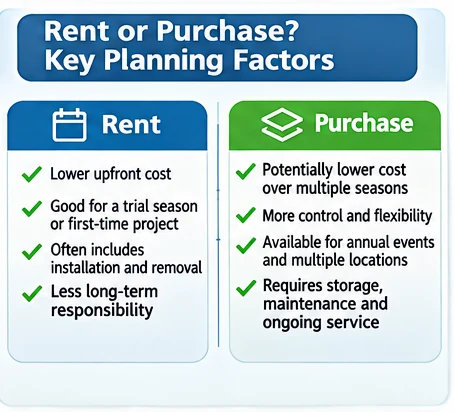
Neither option is universally less expensive or more appropriate. The answer depends on the intended operating model and the full scope of each agreement.
9. Determine who will operate the skating rink
A city may be capable of funding a rink without having staff trained to operate one.
Several arrangements are possible.
Full-service event operation: An outside organization provides the rink and handles much of the public-facing event operation.
Equipment with local operation: The organizer arranges equipment and technical support, while municipal employees or local contractors handle daily operations.
Owner-operated rink: A municipality, nonprofit or property owner owns the equipment and manages operations internally or through contractors.
Whatever model is chosen, responsibilities need to be clearly documented.
Someone must manage:
- Ticket sales and reservations.
- Skate rentals and fitting.
- Guest supervision.
- Ice maintenance.
- Equipment inspections.
- Cleaning and sanitation.
- Customer questions and incident response.
- Weather closures.
- After-hours technical issues.
- Daily opening and closing procedures.
It is particularly important to understand what happens if equipment needs attention at night, during a holiday or when the rink is full.
An effective contract identifies which organization is responsible for each part of the operation.
10. Plan for insurance, accessibility and safety
A public ice skating rink is a recreational facility requiring appropriate safety management.
Insurance requirements depend on the location, ownership arrangement, operating model and applicable contracts.
Cities and event producers should work with qualified insurance advisers and relevant public officials to establish appropriate coverage.
The Municipal Excess Liability Joint Insurance Fund's best-practices guidance for temporary ice rinks covers similar ground, including general rink safety, operating and risk-management considerations.
Other important considerations include:
- Accessible routes and changing areas.
- Safe entrances and exits.
- Suitable skating barriers.
- Posted operating rules.
- Supervision and emergency procedures.
- First-aid arrangements.
- Ice-condition inspections.
- Weather-related closure procedures.
- Electrical safety.
- Crowd management.
- Emergency vehicle access.
Some jurisdictions require temporary-use permits, electrical inspections, structural review or other approvals.
These vary by location.
No general article can substitute for project-specific engineering, public-safety review or local permitting requirements.
Safety planning should begin well before the rink is installed.
11. Design a complete visitor experience
The ice surface is the main attraction, but the surrounding experience influences whether visitors enjoy the event.
Consider the visitor's journey from arrival through departure.
Can guests locate the entrance?
Is ticketing straightforward?
Is there an organized area for exchanging shoes for skates?
Can parents comfortably watch their children?
Are walkways clearly marked and suitably protected from slipping?
Is there adequate lighting after dark?
Depending on the location and budget, a skating attraction may also include:
- Holiday lighting.
- Music.
- Food and refreshments.
- Photo opportunities.
- Private group sessions.
- School events.
- Themed skating nights.
- Beginner skating assistance.
- Nearby shopping and dining.
- Sponsor-supported community sessions.
A successful holiday rink does not necessarily need elaborate decorations or expensive entertainment.
Reliable ice, a welcoming environment, understandable rules and practical visitor amenities are often more important than complicated programming.
12. Start planning months before opening
For a new attraction opening in November or December, planning well in advance allows time to evaluate locations, utility requirements, procurement obligations, equipment availability and operating arrangements.
An illustrative planning schedule could look like this:
| Stage | Example activities |
|---|---|
| 9–12 months before opening | Establish objectives, evaluate possible sites and identify funding |
| 6–9 months before | Study feasibility, operating model and procurement requirements |
| 3–6 months before | Complete contracts, permits, utility coordination and technical planning |
| 1–3 months before | Finalize staffing, ticketing, marketing, logistics and operating procedures |
| Opening period | Install equipment, build ice, train personnel and complete safety checks |
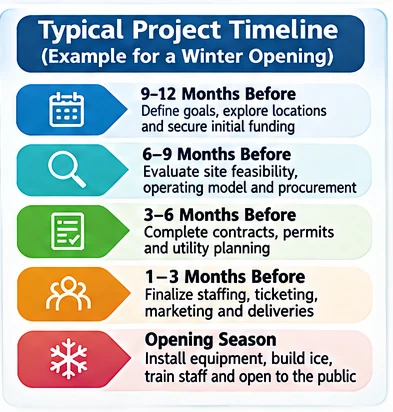
These are suggested planning allowances, not mandatory industry schedules or guaranteed lead times.
Established recurring rinks may complete some steps faster because they already have equipment, operating procedures and infrastructure.
First-time projects with substantial site preparation or public procurement requirements may need considerably more time.
The goal is to identify major dependencies early enough to make informed decisions.
Free Temporary Ice Rink Project Planning Checklist
Planning a holiday ice rink for your city, downtown district or special event? Download our free one-page worksheet covering site preparation, refrigeration, budgeting, operations and opening schedules.
Download the Free Planning Checklist (PDF)
Free one-page PDF · No registration or email required
A practical checklist before requesting proposals
An organizer can make the initial planning process more efficient by preparing a brief description of the project.
Include the following information where available:
- City and state.
- Proposed rink address or location.
- Available footprint or desired rink dimensions.
- Planned operating dates.
- Expected public operating hours.
- Indoor or outdoor location.
- Surface conditions and any known slope.
- Available electrical service.
- Water availability.
- Drainage conditions.
- Freight and installation access.
- Expected visitor volume.
- Whether rental skates and beginner aids are needed.
- Whether the organizer needs equipment only or a fully operated event.
- Whether the rink will operate for one season or return annually.
- Applicable funding, procurement and permitting requirements.
Site photographs, an overhead map and approximate dimensions are particularly useful during early feasibility discussions.
The organizer does not need every answer before beginning research.
However, identifying unknowns early reduces the risk of comparing proposals based on incomplete assumptions.
Frequently asked questions
Can a temporary ice rink be installed in a parking lot?
Often, yes. Parking lots can offer suitable open space and delivery access, but the surface, slope, drainage, electrical infrastructure and surrounding circulation must be evaluated before installation.
How does a temporary rink keep real ice frozen?
A refrigerated rink uses cooling equipment to circulate chilled liquid through a system beneath the ice. The refrigeration plant removes heat so the skating surface can remain frozen.
Does outdoor temperature have to be below freezing?
Not necessarily. Mechanically refrigerated rinks can operate above freezing, although the suitable operating conditions depend on the system design, site and weather.
How long does a temporary ice rink take to install?
Installation time varies with the size, equipment, site preparation and weather. Organizers must allow for installation, utility connections, testing and construction of the ice surface.
Can temporary ice rinks operate indoors?
Yes. Temporary indoor real-ice rinks are possible, but humidity, condensation, electrical capacity, flooring, ventilation and building conditions require careful evaluation.
Are temporary ice rinks made with real ice?
Some are. Refrigerated real-ice rinks use frozen water. Synthetic skating surfaces use engineered panels and operate differently. Organizers should specify which experience they want.
Is renting a portable rink cheaper than buying one?
It depends on how frequently the rink will operate, the full rental scope, purchase price, maintenance, storage, installation responsibilities and equipment service life.
Does the equipment supplier also operate the rink?
Not necessarily. Some agreements include full event operations, while others cover equipment, installation or technical support only.
Can a holiday rink help local businesses?
A well-promoted rink may attract additional visitors to a downtown district or commercial property. Actual economic effects depend on attendance, visitor spending, costs and local circumstances.
How early should a city begin planning a holiday rink?
For a first-time project, beginning six to twelve months in advance can provide useful time for feasibility, funding, procurement and site coordination. More complicated projects may require longer.
Planning a holiday ice rink for your community?
If you're considering a temporary skating rink for a city, downtown district, shopping center, nonprofit or holiday event, begin by identifying the proposed location, available space, operating dates and goals.
IceRinkGuide covers seasonal skating destinations throughout the United States and welcomes questions about planning topics that would be useful to our readers.
Have a rink-planning question or a project to tell us about? Contact Tim at IceRinkGuide.
When writing, please include your city, approximate rink dimensions, proposed season and the question you're trying to answer.
IceRinkGuide is an independent skating-information publication, not a rink equipment seller or event operator. Contacting the publication does not constitute a supplier quotation request or a promise of professional project consulting.